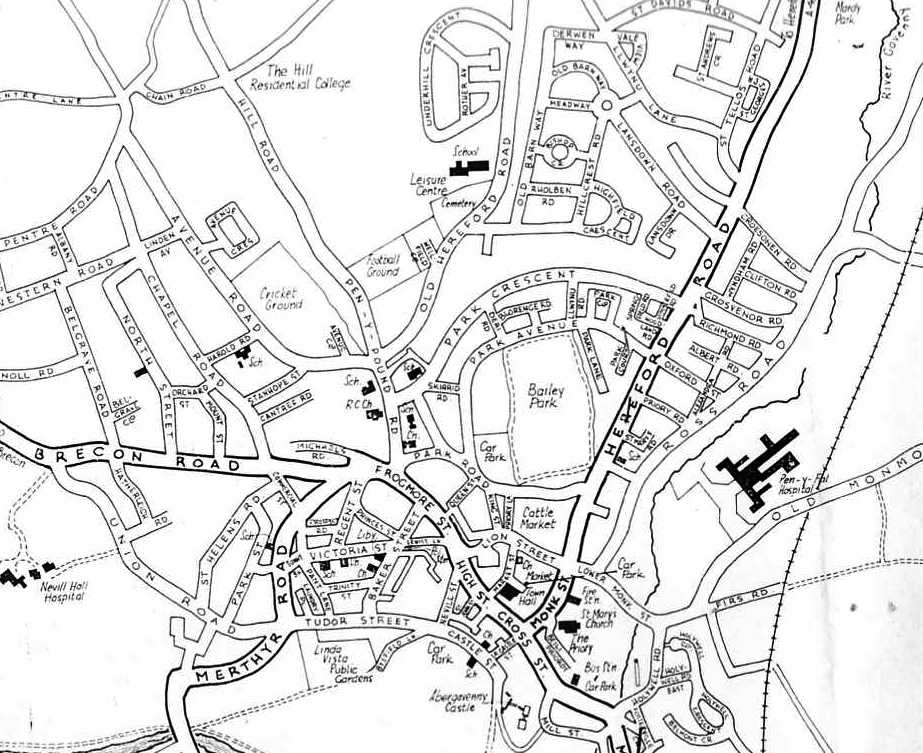
REVIEW OF THE ABERGAVENNY WITCH HUNT
BY TIM PENDRY
Self published but no less useful for that - indeed, although there are disadvantages (one or two lapses in editing, design infelicities and a structural approach which we will come on to), self-publishing enables new and important material to come into the public domain.
What William Cross has done is provide the raw
data (unusual in itself) about a rather unpleasant incident in British social
history that allows us to make up our own mind about its meaning, sandwiched
between acute and humane analysis and an excellent series of notes.
This incident was the prosecution of over twenty
homosexuals in a small Welsh town in the middle of the second world war. It is
a foot-note in the long and grim story of gay persecution in the UK before the
1960s but an important one.
I am not convinced by the speculative attempt to
pull Evan Morgan, Viscount Tredegar, into the story but Cross seems to have an
almost obsessive research interest in this aristocrat and his circle. The
appendix (for that is what it is) does not detract from the whole.
However, the benefit of having the full raw data
creates the structural problem. The book is analysis and data but not always
easy to read narrative or analysis of the raw data itself. He leaves much of
the interpretation to us.
I tend to approve of this because I find a lot
of narrative history to be half-truth by selection but most readers will not
find it helpful so it loses a GoodReads point. They want an easy read and not
to have to do the researchers job for them - fair enough up to a point.
The problem of narrative in history is the same
as the 'story' in journalism. We like stories and stories are fiction. Making
facts easy to digest and culturally palatable immediately partly fictionalises
them. Most journalism and history is, in fact, part-fiction.
Although not a set narrative (but Cross writes
clearly), his account (other than the speculation around Tredegar) sounds true
to me. One learns more about the actuality of 'gay' life in mid-twentieth
century Britain from Cross than from many others in this field.
And what do we learn? Obviously that homosexuals
were treated appallingly in British Imperial Christian culture, not from malice
(at least in most cases) but from ignorance and prejudice. This much we knew.
What this book pinpoints is the complexity of
that culture with its internal contradictions that are not easy to see in
simple black and white terms.
The evidence tends to show that this ignorant
and prejudiced culture still expressed itself in terms that were far from
sadistic and often moderated through a kind of random if judgmental compassion
that inherited the unthinking instincts of the wider culture.
Nasty authoritarian types tended to grab hold of
the legislative process to make changes regardless of the lack of interest and
even compassion of the 'masses' and then impose draconian laws on a judicial
system that then tried to square it with human reality.
There is no doubt that an underground sexual
culture must tend to viciousness - the anxious, frightened and those with most
to lose will be deterred from their instinctive practices but the hard and
sociopathic cases will not.
As a result, the continuum from consensual sex
between adults back into grooming and exploitation of young poor working class
males (ephebophilia shading into paedophilia) meant that we are dealing in this
book not just with some standard alleged witch hunt against gays.
We are dealing with what would be recognised as
a paedophiliac network embedded within a gay culture and there is much to learn
from this about the sociology of sex and the law, what happens when the State
hunts as a pack and how things can go wrong.
The overwhelming lesson is that sexual culture
is incredibly contingent on a wider cultural set of assumptions about what is
right and wrong. Observation today of Greater Syria, Moscow and Uganda tells us
as much.
We, in the West, seem currently to have settled
on the notion of consent and the reasonable notion that minds that are not
fully developed cannot be said to be consenting minds.
This allows us to bring homosexual (and indeed
bisexual and polyamorous) relationships into the mainstream as simply private
matters, while ensuring that we have laws that protect at least under-16s from
exploitative grooming (even if appallingly enforced).
But we all know that in the UK this is a bit of
an arbitrary fix and, as more liberal interpretations of consent are under
siege and on the wane, conservative models are placing the system under
pressure by extending exploitation upwards into consensual sexual trade.
The decisions about what is a private matter in
sexual relations thus remain fluid in time and somewhat arbitrary even today.
Even the 16-age limit in the UK is an arbitrary fix which other cultures refuse
to pull into the ambit of the criminal law.
In the Abergavenny Case, we have an enormous
range of individual stances - the uncertain and lonely vulnerable lad unsure of
his identity, the manipulative sociopath and the victim of rape and this
extends up in time to 21 as much as down to 14/15.
The same range of attitudes to sexuality
probably applies to young women in the current grooming cases so deeper
questions lie in at what stage do young people take rights over their own
bodies and lives and what actual (rather than presumed) harms are involved.
This is all too sophisticated for the blunt
instrument of the law and English and Welsh practice has tended to try to treat
the powers it has as reserve powers and not inquire too deeply into private
life lest it uncover the sheer scale and unmanageability of things.
This has two effects. The first is that horrible
things as well as a great deal of freedom carry on as if there was no law.
Administrators and coppers muddle through - with dreadful consequences when
they get it wrong as they have done over child abuse.
The second is that, every now and then, there is
a political or moral panic or some unfortunate case is forced on the
Establishment and 'justice has to be seen to be done'. Some show trial or
investigation becomes necessary 'pour encourager les autres'.
In the last two decades, this has degenerated
into 'law enforcement for the cameras' - camera crews watching doors being
beaten down by troops of armoured men when a knock on the door by a local
copper would have sufficed - and sudden surges of draconian idiocy.
It started with the asinine 'tough on crime,
tough on the causes of crime' that resulted in kids being neglected to get
better records of property crime in northern cities - what a disaster New
Labour was! - and ends with Cameron denying evidence on drugs harms.
This is, in short, a mid-twentieth century
system out of its depth, administratively incompetent and unable to see the
wood for the trees. William Cross' book helps us to see that a system that was
inhumane but sort of worked is now in its final degenerate stage.
A lot of the problem comes from the flip dark
side of the social revolution of the 1960s and 1970s that enabled marginal
populations like the gay population their freedoms and which undermined the
cultural primacy of the 'Establishment'.
No one will face the facts that the human
condition is complex, that the millions of people in a modern State will act in
diverse ways if they are free to do so and that the State, shorn of its terror and
monoculture, has to find new ways to administer this.
At the moment, every activist and NGO or lobby
group drives Government this way and that to place more and more demands on a
second rank administrative service hobbled by procedures and processes driven
by rights legalism. Yet there is not, fact, the funds for such a system.
The Soviets could not handle this problem of the
human condition - our very nature - and yet they could print money and order
people around at will. The Fascists just took the dark side and directed it
outwards.
Our establishment, quite rightly (as the Fiona
Woolf case has shown) is now surplus to requirements, our political class is
despised and at sea and our administrators are asked to do more than is humanly
possible and then are frightened by the risk of failure into inaction.
Take paedophilia. NGO lobbyists pushed a single
policy (so typically because NGOs think in simplicities) of hunting down those
who downloaded kiddy porn, largely to create a 'strategy of fear' for those who
remained.
The police, reasonably, followed the law, did
their best and used their very limited resources to undertake
intelligence-based policing to round up networks. Taking kiddy porn off the
internet is a 'good' but it is not a strategy against organised crime which is
what this is.
It now transpires that the fear factor only
works on non-dangerous males dabbling on the internet, that something like
60,000 people are still looking at these images and that only something like 2%
have been apprehended and sentenced at huge cost.
Worse, about 30% of those charged are judged
informally by law enforcement as actually not dangerous to children but their
lives have been ruined. They do time because they are idiots (which is not
really a crime per se) and because others like them need to be terrorised.
If we postulate that the sociopathic predators
and dangers to children are so committed to their ways of life that they will
become increasingly devious within their networks and create counter-measures,
then it sounds to me like the dangers are getting worse.
This single issue approach is like concentrating
on bringing down celebrities for the tabloids instead of going deep into the
state's own care home system, the public schools or into the churches (oh, no,
never touch the churches) to root out organised child abuse.
There is much in William Cross' book to give us
food for thought in this context - for welfare state, read warfare state. The
imperial system seemed oddly tolerant of public school sexual exploitation
while a theme of military homosexuality runs through the book.
In other words, in dealing with 'sexual crimes'
we seem to have learned nothing since 1942 - we have not learned to define the
harm, we have not learned the difference between harms and we have evaded
investigating institutional structures that promote crime.
The strategy remains one of evasion and fear -
targeting scapegoats, failing to frame laws on evidence, failing to invest
funds in strategic law enforcement, using cultural terror as an instrument of
policy and allowing policy to be dictated by passionate activism.
The bottom line on our current crisis
(paedophilia) is still that of consent and of vulnerability.
We have to face the fact that we have tens of
thousands of people driven, like homosexuals a century earlier, by sexual urges
but, because of the harms and unlike homosexuals, who need to be contained in a
dynamic, aggressive but feasible and (I believe) humane way.
We also have to face the fact that we have pockets
of mostly migrant but also underclass males with an instinctive view of women
as 'things' and we also need to deal directly and immediately with the harms
involved in an evidence-based way.
Again, Cross' book is suggestive - homosexuals
had many different atitudes to their own 'condition' (seen as not much better
then than paedophilia) and no doubt modern abusers are much the same.
However, if we had had a serious understanding
of harm in 1942, no consenting adult would have had to go to jail and every
adult guilty of sexually molesting or grooming someone immature would have been
dealt with solely on that basis in a draconian way.
Things seem to be better now because at least we
understand that the harm to the young is proven but the language is still
absurdly based on moral disgust and not on an evidence-based commitment to
protecting all young people instead of running down those who disgust us.
This creates a simulacrum of that underground
that existed for homosexuals in the first half of the twentieth cetury, a world
of misery, loneliness, desperation and fear but also of increased viciousness
and exploitation.
An evidence-based policy on child abuse would
evade nothing - not the minor public schools, not the care system, not the
churches and, above all, the most evaded of all and yet the largest source of
abuse in society, the family.
So, this self-published book on local history
acts as a window on our own times, a reflection on how far we have not progressed. The re-telling of the story of the
gay trials of 1942 is welcome in that context.
https://twitter.com/timpendry
